
GST Judicial Precedents


Original price was: ₹2,795.00.₹2,096.00Current price is: ₹2,096.00.
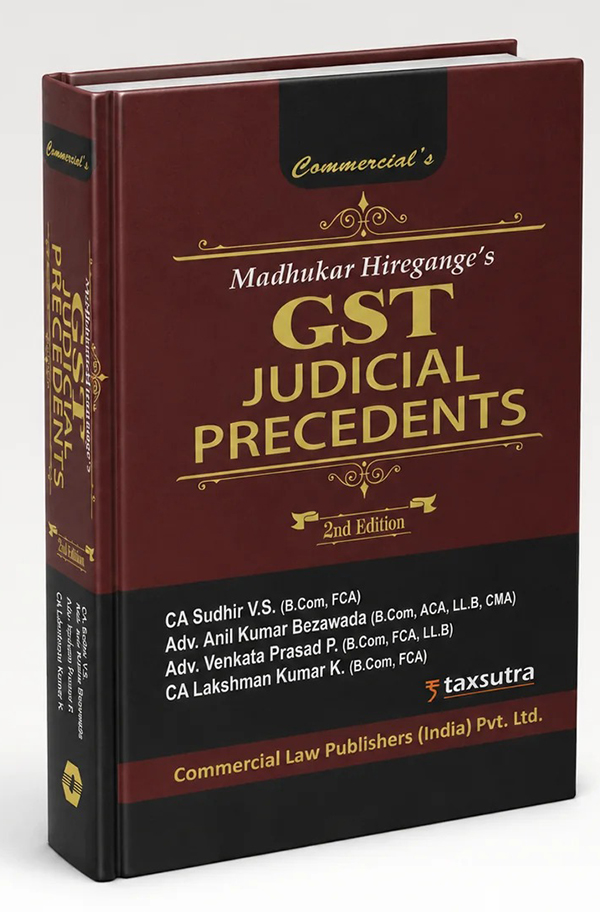
| Book Name | GST Judicial Precedents |
|---|---|
| Author | Madhukar N Hiregange, Sudhir V. S., Anil K. Bezawada, Venkata Prasad P, CA Lakshman Kumar Kadali |
| Publisher | Commercial Law Publishers |
| Edition | 2nd Edition 2026 |
| ISBN | 9789378339776 |
| Pages | 1320 |
(Flat 25% Discount for a limited period + Free Shipping )
- Description
- Additional information
- Reviews (0)
Description
Get flat 25% discount for a limited period on the book ‘GST Judicial Precedents‘ by Madhukar N Hiregange, Sudhir V. S., Anil K. Bezawada, Venkata Prasad P and CA Lakshman Kumar Kadali. This edition, published in 2nd Edition 2026, is packed with valuable insights on GST with a total of 1320 pages. The book covers a wide range of topics, including introduction and GST overview, legal remedies available under GST, principles of interpretation, constitutional aspects, levy and collection, supply, classification, exemptions, input tax credit, refunds, transitional provisions, assessment and audit, demands and adjudication, appeals and revision, recovery proceedings, offences and penalties, anti-profiteering, and amnesty scheme in indirect taxes. Enjoy free shipping on your order. Don’t miss this opportunity to enhance your understanding of GST through comprehensive judicial precedents. ISBN: 9789378339776
| Section | Particulars | Page No. |
|---|---|---|
| PART-I | ||
| CHAPTER-1—INTRODUCTION & GST OVERVIEW | ||
| 1.1 | Introduction | 3 |
| 1.2 | Tax and Levy | 4 |
| 1.2.1 | Terms “Tax” and “Taxes” | 4 |
| 1.2.2 | Tax and Fees | 5 |
| 1.2.3 | Power to levy tax | 7 |
| 1.3 | Concept & Legal Framework of GST | 9 |
| 1.3.1 | Key Features of the Model | 10 |
| 1.3.2 | Overview of GST Law | 11 |
| 1.3.3 | Payment of Taxes under Respective Heads | 14 |
| 1.3.4 | Advantages of GST | 16 |
| 1.3.5 | Taxes Subsumed Under GST | 17 |
| 1.4 | Judicial View on Critical Aspects of GST | 21 |
| 1.5 | Case Laws under Erstwhile Laws | 28 |
| CHAPTER-2—LEGAL REMEDIES AVAILABLE UNDER GST | ||
| 2.1 | Introduction | 32 |
| 2.2 | Legal Remedies under GST law | 33 |
| 2.2.1 | Adjudication– Ascertaining the demand (Section 73/ section 74) | 33 |
| 2.2.2 | Appeals | 35 |
| 2.2.2.1 | Appeal to First Appellate Authority (Section 107) | 37 |
| 2.2.2.2 | Appeal to Appellate Tribunal (Section 112) | 38 |
| 2.2.2.3 | Appeal to High Court (Section 117) | 39 |
| 2.2.2.4 | Appeal to the Supreme Court (Section 118) | 39 |
| 2.2.2.5 | Constitutional Remedies | 39 |
| 2.3 | Principles while pursuing legal remedies | 41 |
| 2.3.1 | Only the aggrieved party can seek legal remedies | 41 |
| 2.3.2 | Time Limits | 41 |
| 2.3.3 | Pre-deposits | 42 |
| 2.3.4 | The case cannot be re-opened based on a decision on another person’s case | 43 |
| 2.3.5 | The order becomes final if not appealed against | 44 |
| 2.3.6 | Recovery follows the final orders | 44 |
| 2.3.7 | Principles of Natural justice should be followed | 44 |
| 2.3.8 | Jurisdiction | 45 |
| 2.3.9 | Judicial Discipline | 45 |
| 2.3.10 | Not on assumptions/inferences- | 46 |
| 2.3.11 | Reasoned & speaking order | 46 |
| 2.3.12 | Res judicata | 48 |
| 2.3.13 | Res Integra: | 48 |
| 2.3.14 | Doctrine of Merger | 48 |
| 2.3.15 | Effect of Setting aside the orders | 50 |
| 2.3.16 | Circulars issued by Board/Government | 50 |
| PART-II | ||
| CHAPTER-3—PRINCIPLES OF INTERPRETATION | ||
| 3.1 | Introduction | 54 |
| 3.1.1 | Purpose | 54 |
| 3.1.2 | Statutory Interpretation as understood by Theorists. | 55 |
| 3.2 | Internal and External Aids of Interpretation | 56 |
| 3.2.2 | External Aids | 58 |
| 3.2.3 | Relevancy of General Clauses Act in Interpretation | 59 |
| 3.3 | Fundamental Principles of Interpretation | 61 |
| 3.3.1 | Legislative Competence to levy | 62 |
| 3.3.2 | Elements of proper levy | 64 |
| 3.3.3 | Standard Principles of Interpreting a Taxing Statute | 65 |
| 3.3.4 | Principle of Plain Meaning (Literal Construction) | 71 |
| 3.3.5 | Purposive Construction (Intention of Legislature) | 76 |
| 3.3.6 | Doctrine of Casus Omissus | 78 |
| 3.3.7 | Mischief Rule | 80 |
| 3.3.8 | Principle of Harmonious Construction | 81 |
| 3.3.9 | Doctrine of Beneficial Construction | 83 |
| 3.3.10 | Strict Construction of Penal Statutes | 84 |
| 3.3.11 | Strict and liberal Construction of a Procedural Notification | 86 |
| 3.4 | General Principles and presumptions in Interpretation | 87 |
| 3.4.1 | Act should be read as per updated conditions | 87 |
| 3.5 | Use of Punctuations in Interpretation | 87 |
| 3.6 | Interpretation of Words Unidentified in the Statute | 88 |
| 3.6.1 | “Shall” and “May” | 88 |
| 3.6.2 | “As far as possible” | 89 |
| 3.6.3 | “Bona fide Mistake” | 90 |
| 3.6.4 | “In relation to” | 90 |
| 3.6.5 | “In respect of” | 90 |
| 3.6.6 | “Not less than” | 91 |
| 3.6.7 | “Reasonable Time” | 91 |
| 3.6.8 | “Going Concern” | 91 |
| 3.6.9 | “Slump Sale” | 92 |
| 3.7 | Doctrine of Precedent | 92 |
| 3.8 | CONCLUSION | 94 |
| PART-III | ||
| CHAPTER-4—LEGAL MAXIMS WITH PRACTICAL EXAMPLES | ||
| 4.1 | Introduction | 98 |
| 4.2 | Maxims – Illustrated and Classified | 100 |
| 4.2.1 | Ab Initio | 102 |
| 4.2.2 | Actio Personalis Moritur Cum Persona | 103 |
| 4.2.3 | Actus Non Facit Reum, Nisi Mens Sit Rea | 103 |
| 4.2.4 | Audi Alteram Partem | 105 |
| 4.2.5 | Actori incumbit onus probandi | 107 |
| 4.2.6 | Actus Reus | 108 |
| 4.2.7 | Actus Curiae Neminem Gravabit | 108 |
| 4.2.8 | Cursus Curiae Estlex Curiae | 109 |
| 4.2.9 | Caveat emptor | 109 |
| 4.2.10 | De Facto | 110 |
| 4.2.11 | De Minimis Non Curat Lex | 110 |
| 4.2.12 | Delegatus Non-Potest Delegare | 110 |
| 4.2.13 | Discretio est discernere per legem quid sit justum | 112 |
| 4.2.14 | Ejusdem Generis | 113 |
| 4.2.15 | Ex Post Facto | 114 |
| 4.2.16 | Expressio Unius Est Exclusio Alterius | 115 |
| 4.2.17 | Generalia Specialibus non derogant | 116 |
| 4.2.18 | Ignorantia juris non excusat | 117 |
| 4.2.19 | In Absentia | 117 |
| 4.2.20 | Interpretare et concordare leges legibus est optimus interpretendi modus | 118 |
| 4.2.21 | Leges Posteriores Priores Contrarias Abrogant | 118 |
| 4.2.22 | Lex Non Cogit Ad Impossiblia | 119 |
| 4.2.23 | Locus Standi | 120 |
| 4.2.24 | Modus Operandi | 121 |
| 4.2.25 | Mutatis Mutandis | 121 |
| 4.2.26 | Nemo Debet Esse Judex in Propria Sua Causa (‘nemo judex in causa sua’) | 123 |
| 4.2.27 | Nemo Debet BisVexari (Pro Una Et Eadem Causa) | 124 |
| 4.2.28 | Non-Obstante | 124 |
| 4.2.29 | Noscitur a Sociis | 126 |
| 4.2.30 | Nova Constitutio Futuris Formam Imponere Debet, Non Praeteritis | 127 |
| 4.2.31 | Obiter Dicta | 128 |
| 4.2.32 | Pari Materia | 129 |
| 4.2.33 | Per Incuriam | 130 |
| 4.2.34 | Res Integra | 130 |
| 4.2.35 | Sublato Fundamento Cadit Opus | 131 |
| 4.2.36 | Ubi Non Est Principalis Non Potest Esse Accessorius | 132 |
| 4.2.37 | Ubi Jus Ibi Remedium | 132 |
| 4.2.38 | Vigilantibus et non dormientibus jura sub veniunt | 132 |
| 4.2.39 | Commodum Ex Injuria Sua Memo Habere Debet | 132 |
| 4.2.40 | Sub Silentio | 133 |
| 4.2.41 | Reformatio In Peius | 134 |
| 4.2.42 | Doctrine of Necessity | 134 |
| 4.3 | Conclusion | 135 |
| PART-IV | ||
| CHAPTER-5—CONSTITUTIONALITY | ||
| 5.1 | Introduction | 141 |
| 5.1.1 | Taxing Entries under Central Tax | 144 |
| 5.1.2 | Taxing Entries under State Tax | 145 |
| 5.1.3 | Taxing Entries under Concurrent Tax | 150 |
| 5.1.4 | Definitions under GST inserted through the Constitution | 156 |
| 5.2 | Constitutional mandate and limitations under GST Law | 157 |
| 5.2.1 | Constitutional Mandate | 157 |
| 5.2.2 | Constitutional Limitation | 158 |
| 5.2.2.1 | Fundamental Rights | 159 |
| 5.2.2.2 | Breach of Fundamental Rights | 161 |
| 5.2.2.3 | Constitutional Validity of RBI’s decision to Ban “Merchanting Trade Transaction” – Test of Proportionality | 162 |
| 5.2.2.4 | Inequitable Taxation – principle to compensate injustice | 163 |
| 5.2.3 | Authority to levy and Transitional Provision | 164 |
| 5.2.3.1 | Challenging the vires of Rule 117 | 165 |
| 5.2.3.2 | Upholding the vires of Rule 117 | 167 |
| 5.2.3.3 | Constitutional Validity of the Retrospective Amendment | 167 |
| 5.2.4 | Constitutional Limitation on Provisional Attachment of Bank Account | 169 |
| 5.2.5 | Constitutional Limitation on Blocking Credit Ledger under Rule 86A | 170 |
| 5.3 | Constitutional Validity | 172 |
| 5.3.1 | Constitutional validity of GST (Compensation to States) Act, 2017 | 172 |
| 5.3.2 | Constitutional Validity of the Savings and Repeal Clause | 176 |
| 5.3.3 | Constitutional Validity of Demand and Recovery in GST | 179 |
| 5.3.4 | Constitutional Validity of Section 16(2)(c) of the CGST Act, | 2017 |
| and Rule 36(4) of the CGST Rules, 2017 | 182 | |
| 5.3.6 | Constitutional Validity of RCM on Security Services | 187 |
| 5.3.7 | Constitutional Validity of Section 16(4) of the CGST Act, 2017 | 188 |
| 5.3.8 | Constitutional Validity of Press Release | 191 |
| 5.3.9 | Constitutionality of Arrest and Prosecution under GST | 191 |
| 5.3.10 | Constitutional Validity of Section 7(1)(aa) of the CGST Act, 2017 – Services provided by association to its members | 194 |
| 5.3.11 | Constitutional validity of Section 17(5)(c) and 17(5)(d) of the CGST Act, 2017 | 196 |
| 5.3.13 | Constitutional validity of Rule 96(10) | 199 |
| 5.3.14 | Constitutional Validity of GSTR-3B as a return | 202 |
| 5.3.15 | Constitutional Validity of Rule 89(5) – Refund under Inverted Duty Structure | 203 |
| 5.4.2 | Detention of vehicle on alleged “wrong destination” when all documents carried ultra vires the Constitution | 208 |
| 5.4.3 | Constitutional Validity of Rule 31A(3) of CGST Rules | 209 |
| 5.4.4 | Constitutional validity of mandatory deduction of 1/3rd land value | 210 |
| 5.5.1 | Possible Areas to Challenge Constitutionality Constitutional Validity of GST on Mining Royalty | 212 |
| 5.5.2 | Constitutional Validity on levy and valuation of Coporate Guarantee | 213 |
| 5.5.4 | Constitutional Validity on deemed valuation provided in Entry 201A of Notification No. 01/2017-Central Tax (Rate) | 217 |
| 5.5.5 | Constitutional Validity of valuation on landowner’s share | 218 |
| 5.4 | Landmark Decisions under the Erstwhile Law | 219 |
| CHAPTER-6—LEVY & COLLECTION | ||
| 6.1 | Introduction | 222 |
| 6.2 | The decision regarding the levy of GST | 223 |
| 6.2.1 | Constitutional Validity of Compensation Cess Act | 223 |
| 6.2.2 | The constitutional validity of Section 13(8)(b) of IGST Act, 2017 (Place of supply for an intermediary): | 224 |
| 6.2.3 | Nature of tax – CGST + SGST or IGST | 229 |
| 6.2.4 | Levy of GST on liquor license | 230 |
| 6.2.5 | C-Forms issued for High-Speed Diesel [HSD] | 230 |
| 6.2.6 | Levy of GST on Freight | 231 |
| 6.2.7 | Whether notification of one State can be subjected to judicial scrutiny of a High Court beyond its Territorial Jurisdiction of that State? | 233 |
| 6.2.8 | Levy of Market Fee | 234 |
| 6.2.9 | Levy of Tax on supplies made by or to Duty-Free Shops | 234 |
| 6.2.10 | Levy of Advertisement Tax | 237 |
| 6.2.11 | Levy of Entertainment tax | 237 |
| 6.2.12 | Deferred payment of VAT for Sick Industries | 237 |
| 6.2.13 | Validity of levy of 1% of court fees on the filing of appeal before Appellate Authority under GST in the State of Kerala | 238 |
| 6.2.14 | Validity of deemed 1/3rd land deduction | 239 |
| 6.2.15 | Exclusion of Ice Cream Manufacturers from Composition scheme | 240 |
| 6.2.16 | Customs duty does not include Integrated Tax | 241 |
| 6.2.17 | Levy of IGST on import of Oxygen Concentrators | 243 |
| 6.3 | Cases pending under GST | 245 |
| 6.4 | Possible Areas of disputes in GST | 245 |
| 6.4.1. Notifications under GST Law must conform to GST council recommendations | 245 | |
| 6.4.2 | The constitutional validity of Notifications and Circulars levying GST on development rights before 01.04.2019 on the landowner: | 245 |
| 6.4.3 | The constitutional validity of Notifications and Circulars levying GST after 01.04.2019 on development rights on unsold stock on the date of issue of completion certificate under reverse charge mechanism on the developer | 246 |
| 6.4.4 | Levy of GST on Extra Neutral Alcohol | 247 |
| 6.4.5 | Levy of GST on royalty paid to Government for giving the right to extract natural resources | 248 |
| 6.4.6 | Refund of GST on account of cancellation of contract | 249 |
| 6.4.7 | No GST on affiliation fess paid to the Universities | 250 |
| 6.4.8. No GST on regulatory fees collected by the State Electricity Regulatory Commission | 251 | |
| 6.4.9 | Prospective effect of Notification | 251 |
| 6.4.10 | No GST on the Solatium paid as part of compensation. | 251 |
| 6.5 | Case Laws relating to Levy & Collection in pre-GST regime | 252 |
| 6.6 | Decisions are given under Foreign GST Law and its relevancy to Indian GST | 264 |
| 6.6.1 | Taxability of Amounts Collected by Development Councils | 264 |
| 6.6.2 | Taxability of samples distributed for marketing | 265 |
| 6.6.3 | Taxability of unused air tickets on account of non-travel by passenger | 265 |
| CHAPTER-7—MEANING & SCOPE OF SUPPLY (TAXABLE EVENT) | ||
| Introduction | 268 | |
| 7.1 | Decisions under GST Law | 269 |
| 7.1.1 | Concept of mutuality | 269 |
| 7.1.2 | Transfer of development rights and immovable property related transactions | 270 |
| 7.1.3 | Classification of services – offline/online games such as Rummy games of chance or skill? | 273 |
| 7.1.4 | Reciprocity of obligations is necessary to make a supply. Damages in contrast to ‘consideration’ | 274 |
| 7.1.5 | Actionable claim: | 275 |
| 7.1.6 | Long-term lease equivalent to a sale of land? | 277 |
| 7.1.7 | Lottery tickets treated as goods or not? | 278 |
| 7.1.8 | Supplying instruments/equipment to unrelated parties without consideration is a ‘supply’ or not? | 279 |
| 7.1.9 | The supply of goods by the charitable trust is a business activity carried out for pecuniary benefits | 280 |
| 7.1.10 | Intermediary services | 280 |
| 7.1.11 | Whether GST is payable on discount received | 282 |
| 7.1.12 | Others | 282 |
| 7.2 | Pending for decisions before HC/SC | 284 |
| 7.3 | Possible areas of disputes under GST | 285 |
| 7.3.1 | Works contract – whether a supply of ‘goods’ or ‘services’: | 285 |
| 7.4.2 | Notice pay recovery collected by an employer from an employee | 285 |
| 7.3.3 | Amounts collected by clubs/associations from its members: | 286 |
| 7.3.4 | Discounts and incentives: | 286 |
| 7.3.5 | Liquidated damages | 288 |
| 7.4 | Decisions under VAT, CE, ST, Allied Laws relevant to GST: | 290 |
| 7.4.1 | The inclusive definition of ‘Supply’: | 290 |
| 7.4.2 | ‘Barter’ | 290 |
| 7.4.3 | Exchange: | 291 |
| 7.4.4 | Definition of ‘Goods’ | 291 |
| 7.4.5 | Definition of Service: | 294 |
| 7.4.6 | Definition of consideration: | 297 |
| 7.4.7 | Definition of ‘Person’: | 299 |
| 7.5.8 | Definition of Business: | 301 |
| 7.4.9 | Sharing of expenses: | 302 |
| 7.4.10 | Notice pay recovery: | 302 |
| 7.4.11 | ‘Gift’: | 303 |
| 7.4.12 | Agency relationship: | 303 |
| 7.4.13 | Transfer: | 304 |
| 7.4.14 | Land and buildings: | 305 |
| 7.4.15 | Process – meaning: | 306 |
| 7.5.16 | Renting of Immovable Property: | 307 |
| 7.4.17 | Construction of Complex, Building, Civil structure: | 307 |
| 7.4.18 | Temporary transfer of IPR: | 309 |
| 7.4.19 | Information Technology Software: | 310 |
| 7.4.20 | Transfer of right to use: | 311 |
| 7.4.21 | Toleration to an act or refrain from an act: | 312 |
| 7.4.22 | Works Contract Service | 315 |
| 7.4.23 | Restaurant Service: | 317 |
| 7.4.24 | Club or association to its members: | 319 |
| 7.4.25 | Employer & Employee: | 319 |
| 7.4.26 | Land and Buildings: | 321 |
| 7.4.27 | Actionable claim: | 321 |
| 7.4.28 | Taxability of Venture Capital Funds | 322 |
| 7.4.29 | Taxability of convenience fees | 323 |
| 7.4.30 | Taxability of interchange fees | 323 |
| 7.4.31 | Taxability in case of merging of companies | 323 |
| 7.4.32 | Taxability of sale of services | 324 |
| 7.4.33 | Taxability of job work services | 324 |
| 7.5 | Decisions given under Foreign GST Law and its relevancy to Indian GST | 324 |
| 7.5.1 | Taxability of goods supplied free of cost against vouchers | 324 |
| 7.5.2 | Taxability of compensation received from the local authority for discontinuation of milk production | 325 |
| 7.5.3 | Taxability of retention of deposit money by the hotel on account of cancellation of the booking | 325 |
| 7.5.4 | Taxability of putting business assets for personal use and input tax reversal | 326 |
| CHAPTER-8—CLASSIFICATION, COMPOSITE & MIXED SUPPLY | ||
| 8.1 | Introduction | 327 |
| 8.2 | Decisions under GST Law | 328 |
| 8.3 | Possible area of a dispute under GST | 362 |
| 8.4 | Old decisions relevant to GST – VAT, CE, ST, Allied Laws | 364 |
| 8.4.1 | Explanatory Notes to the HSN: | 364 |
| 8.4.2 | Rules of Interpretation: | 365 |
| 8.4.3 | Function or use | 373 |
| 8.4.4 | Constituent material | 374 |
| 8.4.5 | Expert Opinion | 374 |
| 8.4.6 | Dictionary meaning | 374 |
| 8.4.7 | Classification by ISI Specification | 375 |
| 8.4.8 | Classification beneficial to the assessee | 375 |
| 8.4.9 | Long-standing classification not to be changed | 376 |
| 8.4.10 | Works Contract | 376 |
| 8.4.11 | Software | 379 |
| 8.4.12 | Others | 380 |
| 8.5 | Decisions are given under Foreign GST Law and its relevancy to Indian GST | 389 |
| CHAPTER-9—EXEMPTIONS UNDER GST | ||
| 9.1 | Introduction & Provisions | 395 |
| 9.2 | Judicial pronouncements under GST | 421 |
| 9.2.1 | Applicability of exemption to charges collected along with charges for transmission and distribution of electricity | 421 |
| 9.2.2 | Exemption applicability to exercise books | 423 |
| 9.2.3 | Exemption applicability to chilling and packing of milk done by contractors to milk dairies | 424 |
| 9.2.4 | Duty of customs does not refer to Integrated tax (IGST) | 425 |
| 9.2.5 | Exemption on supply of branded rice is not available even if the brand is unregistered | 427 |
| 9.2.6 | Renting of immovable property to Backward Classes Welfare Department is exempt from GST | 428 |
| 9.2.7 | Contributions to Residential Welfare Associations (RWA) in excess of INR 7,500 per member per month shall be liable to GST | 428 |
| 9.2.8 | Validity of withdrawal of GST Exemption to auto rickshaws, cabs and non-AC stage carriages providing services through ECOs | 429 |
| 9.2.9 | Loan transaction with a credit card holder by a bank is exempt from GST and it cannot be equated with service of credit card | 430 |
| 9.2.10 | Eligibility of exemption from GST Compensation Cess on Import of Coal by SEZ units | 431 |
| 9.2.11 | Supply of cotton seed oil cake to traders prior to 22.09.2017 is exempt from GST as long as the end use is for cattle feed | 433 |
| 9.2.12 | Interest from defaulting subscriptions of chit is exempted from GST | 433 |
| 9.3 | Judicial pronouncements pending before courts in GST regime: | 434 |
| 9.3.1 | Applicability of exemption to Fish Meal used in manufacture of aquatic/poultry/prawn feed | 434 |
| 9.3.2 | Taxability of Annuity paid as deferred payment for construction and maintenance of roads | 435 |
| 9.4 | Possible areas of dispute | 436 |
| 9.4.1 | What is Going concern not defined? | 436 |
| 9.4.2 | ‘In relation to’ has wide meaning assigned to it, Leading to disputes | 436 |
| 9.4.3 | Statutory and sovereign functions of Government or Municipality not defined under GST | 436 |
| 9.4.4 | Transportation of goods by Road: | 437 |
| 9.4.5 | Exemption to Services in relation to agricultural produce is service specific not person specific: | 437 |
| 9.4.6 | Sale of TDR – Not leviable to GST: | 437 |
| 9.5 | Judicial pronouncements given in earlier law applicable in GST regime | 438 |
| 9.5.1 | Exemptions related to health care services: | 438 |
| 9.5.2 | Ambulance service cannot be called as rent-a-cab service | 441 |
| 9.5.3 | Exemption given only to theatre or drama artist performance is violation of Article 14? | 441 |
| 9.5.4 | Exemption in relation to services of public libraries: | 442 |
| 9.5.5 | Exemptions related to training and coaching services | 443 |
| 9.5.6 | Exemption in respect of stage carriage and contract carriage vehicles | 446 |
| 9.5.7 | Agricultural produce inclusions and exclusions | 446 |
| 9.5.8 | Whether satisfaction of SEZ Act Conditions alone make the assessee eligible for service tax exemption? | 448 |
| 9.5.9 | Eligibility of ST exemption to construction services where work order is issued by BSNL as an implementing agency for ultimate use by Defence Services, GOI. | 450 |
| 9.5.10 | Service tax Levy on Legal services | 451 |
| 9.5.11 | Exemption under Notification 25/2012-ST for construction services provided to railways, including monorail or metro does not cover only “Indian Railways” but any railway, irrespective of the ownership | 452 |
| 9.5.12 | Service Tax is payable on services provided by HGO as the services provided by them does not amount to a religious ceremony | 453 |
| 9.6 | Foreign GST pronouncements relevant to Indian GST | 454 |
| 9.6.1 | Exemptions related to health care services: | 454 |
| 9.6.2 | Exemption3 related to transaction in money | 459 |
| CHAPTER-10 —TIME OF SUPPLY | ||
| 10.1 | Introduction | 462 |
| 10.2 | Decision under GST on time of supply of goods or services | 468 |
| 10.3 | Rationale from important Advance rulings under GST | 470 |
| 10.4 | Possible disputes under GST: | 474 |
| 10.4.1 | Associated Enterprises | 474 |
| 10.4.2 | When advance received in common for supply of goods and services which are neither composite nor mixed supply | 475 |
| 10.4.3 | Deposit v. Advance | 475 |
| 10.4.4 | Vouchers | 476 |
| 10.4.5 | Determination of composite/mixed Supply | 477 |
| 10.5 | Decisions in Pre-GST regime | 477 |
| CHAPTER-11—PLACE OF SUPPLY | ||
| 11.1 | Introduction | 483 |
| 11.1.1 | Central Sales Tax Act, 1956 | 483 |
| 11.1.2 | Export of Service Rules, 2005 and The Taxation of Services (Provided from Outside India and Received in India) Rules, 2006 | 484 |
| 11.1.2.1 | Export of Service Rules, 2005 | 484 |
| 11.1.2.2 | The Taxation of Services (Provided from Outside India and Received in India) Rules, 2006 | 484 |
| 11.1.2.3 | Place of Provision of Service Rules, 2012 | 484 |
| 11.1.3 | Provisions under GST | 486 |
| 11.1.3.1 | Definitions | 486 |
| 11.1.3.2 | Nature of Supply under IGST Act | 486 |
| 11.1.3.3 | Place of Supply | 487 |
| 11.2 | Decisions under GST Law | 493 |
| 11.2.1 | Decisions on Movement of Goods | 493 |
| 11.2.2 | Decisions on Zero Rated Supplies | 494 |
| 11.3 | Pending for decisions before HC/SC | 499 |
| 11.4 | Possible area of a dispute under GST | 499 |
| 11.4.1 | Factory Gate Sale: | 499 |
| 11.4.2 | Renting of Immovable property v. Storage and Warehousing Services | 500 |
| 11.4.3 | Performance Based Services | 502 |
| 11.4.4 | Intermediary services | 502 |
| 11.4.5 | Section 10(1)(b) v. Section 10(1)(d) of the IGST Act, 2017 | 509 |
| 11.4 | Old decisions relevant to GST – VAT, CE, ST, Allied Laws | 510 |
| 11.5 | Decisions given under Foreign GST Law and its relevancy to Indian GST | 520 |
| 11.6 | Old decisions which are not relevant under GST | 521 |
| CHAPTER-12—VALUATION | ||
| 12.1 | Introduction: | 525 |
| 12.2 | Decisions/ruling under GST Law | 526 |
| 12.3 | Pending for decisions before HC/SC | 535 |
| 12.4 | Possible area of the dispute under GST | 536 |
| 12.4.1 | Grossing up of TDS in case of foreign payments | 536 |
| 12.4.2 | Actual Land deduction instead of 1/3rd notional value | 536 |
| 12.4.3 | Commission v. Discount | 537 |
| 12.4.4 | Deduction of Pure agent v. Inclusion in the value of supply | 538 |
| 12.4.5 | Valuation in case of supply by the employer to employee | 538 |
| 12.4.6 | Charges v. Tax | 539 |
| 12.4.7 | Cum-Tax Value | 540 |
| 12.4.8 | Consideration vis-à-vis Deposits | 541 |
| 12.4.9 | Rules u/s. 15(4) v. Notified supplies u/s.15(5) | 541 |
| 12.5 | Old decisions relevant to GST – VAT, CE, ST, Allied Laws | 542 |
| 12.5.1 | Transaction value | 542 |
| 12.5.2 | Price | 544 |
| 12.5.3 | Valuation in case of free supplies (Gifts) | 544 |
| 12.5.4 | Valuation in case of Post Sale Discount/Quantity discount | 545 |
| 12.5.5 | Treatment in case of consideration partly in cash and partly in kind | 546 |
| 12.5.6 | Valuation in case of a barter transaction | 547 |
| 12.5.7 | Valuation in case of subsidies provided by Government | 547 |
| 12.5.8 | Valuation in case of amount incurred by the recipients | 548 |
| 12.5.9 | Price is the sole consideration | 549 |
| 12.5.10 | Reimbursement expenses | 550 |
| 12.5.11 | Tax, Interest and Penalty | 552 |
| 12.5.12 | Charging Section v. Provision for valuation | 554 |
| 12.5.13 | Interest on the retrospective escalation of Price | 554 |
| 12.5.14 | Related Party Transactions | 554 |
| 12.5.15 | Incidental Expenses | 555 |
| 12.5.16 | Valuation in case of Ocean freight: | 556 |
| 12.5.17 | Decisions given under Foreign GST Law and its relevancy to Indian GST | 557 |
| CHAPTER-13—INPUT TAX CREDIT | ||
| 13.1 | Introduction | 561 |
| 13.2 | Judgments in GST regime | 563 |
| 13.2.1 | Seamless flow of Input Tax Credit | 563 |
| 13.2.2 | Input Tax Credit a vested and indefeasible right | 564 |
| 13.2.3 | Condition 16(2)(c) – Payment of Tax by the supplier | 566 |
| 13.2.4 | Payment within 180 days to vendor | 568 |
| 13.2.5 | Time Limit under section 16(4) of CGST Act, 2017 | 569 |
| 13.2.6 | Restricted/Blocked Input Tax Credits | 570 |
| 13.2.7 | Input Service Distributor (ISD) v. Cross Charge | 578 |
| 13.2.8 | Transfer of input tax credit between distinct persons | 579 |
| 13.2.9 | Blocking of Credit Ledger under Rule 86A | 579 |
| 13.2.10 | Restoration of ITC to credit ledger | 581 |
| 13.2.11 | Other Important Issues/Wrongly availed ITC: | 581 |
| 13.3 | Challenge to the Constitutional Validity under GST regime | 583 |
| 13.3.1 | Time Limit under section 16(4) of CGST Act, 2017 | 583 |
| 13.3.2 | Challenging the validity of blockage of credit | 584 |
| 13.3.3 | Challenging the validity of Rule 36(4) | 584 |
| 13.3.4 | Challenging the validity of Rule 86A | 585 |
| 13.4 | Possible Areas of Disputes | 586 |
| 13.4.1 | Whether ITC under GST a vested right or concession | 586 |
| 13.4.2 | Eligibility of credit of CGST & SGST of other States | 586 |
| 13.4.3 | Whether the restrictions provided under section 17(5) of CGST Act is arbitrary and unconstitutional | 587 |
| 13.4.4 | ITC on Plant & Machinery affixed to the earth | 587 |
| 13.4.5 | Rule 36(4) of CGST Rules | 588 |
| 13.4.6 | Rule 86A of CGST Rules | 588 |
| 13.4.7 | Section 16(4) – time limit | 588 |
| 13.4.8 | Section 16(2)(c) – the condition provided is lex non cogit ad impossibilia | 589 |
| 13.4.9 | Receipt of Goods and/or Services – Deemed or only Physical | 589 |
| 13.4.10 | Eligibility of ITC based on TR-6 challan, etc. | 589 |
| 13.5 | Judgements in pre-GST regime | 589 |
| 13.5.1 | Vested Right or a concession | 590 |
| 13.5.2 | Input, Input Services, Capital Goods | 591 |
| 13.5.3 | Meaning – “In the Course of” | 592 |
| 13.5.4 | Meaning – “Furtherance of” | 593 |
| 13.5.5 | The understanding of the negative language with non-obstante clause used in section 16(2) of CGST Act, 2017 | 593 |
| 13.5.6 | Receipt of goods and/or services, documents for availing credit | 593 |
| 13.5.7 | Impossible condition to avail the credit | 594 |
| 13.5.8 | Availability of input tax credit where supplier issued partial financial credit note | 597 |
| 13.5.9 | Time limit for availment of credit | 597 |
| 13.5.10 | Restricted / Blocked Credits | 599 |
| 13.5.11 | ITC on motor vehicles | 599 |
| 13.5.12 | ITC restriction on Food and Beverages | 601 |
| 13.5.13 | ITC on Plant & Machinery | 601 |
| 13.5.14 | ITC on Construction and Works Contract Services | 602 |
| 13.5.15 | ITC on Personal Consumption | 604 |
| 13.5.16 | ITC on goods lost, stolen, destroyed, written off or disposed of by way of gift or free samples | 605 |
| 13.5.17 | Process Loss and Handling Loss: | 607 |
| 13.5.18 | Statutory mandate v. ITC Eligibility | 608 |
| 13.5.19 | Proportionate/Apportionment of credit | 610 |
| 13.5.20 | Credit in special circumstances and Input Service Distributor | 612 |
| 13.5.21 | Availability of Credit on admitted/accepted liability of tax discharged | 613 |
| 13.6 | Relevant international judgements and references to GST law | 613 |
| CHAPTER-14—REGISTRATION, RETURNS AND PAYMENTS SUMMARY | ||
| 14.1 | Registration | 616 |
| 14.1.1 | Introduction | 616 |
| 14.1.2 | Judgments in GST regime | 617 |
| 14.1.3 | Migration | 617 |
| 14.1.4 | Cancellation of Registration | 618 |
| 14.1.5 | Advance rulings relating to registration under GST | 625 |
| 14.1.6 | Threshold limit | 626 |
| 14.1.7 | Liability to get registered | 626 |
| 14.1.8 | Location for Registration | 627 |
| 14.1.9 | Possible Disputes that may arise | 628 |
| 14.1.10 | Judgements in pre-GST regime which may be relevant under GST | 628 |
| 14.1.11 | Relevant International Judgments to GST Law | 630 |
| 14.2 | Returns under GST | 631 |
| 14.2.1 | Introduction | 631 |
| 14.3 | Payments under GST | 644 |
| 14.3.1 | Introduction | 644 |
| CHAPTER-15—REFUNDS | ||
| 15.1 | Introduction | 651 |
| 15.1.1 | Refund of Zero-Rated supply: | 653 |
| 15.1.2 | Refunds in case of duty-free shops: | 657 |
| 15.1.3 | Refund on account of judgment | 659 |
| 15.1.4 | Can excess paid tax be adjusted against future liability? | 659 |
| 15.1.5 | Concept of unjust enrichment: | 660 |
| 15.1.6 | Documentary proof to be submitted to pass the test of unjust enrichment | 664 |
| 15.1.7 | Eligibility of Refund vis-à-vis procedural conditions: | 665 |
| 15.1.8 | Claiming of refund without first challenging assessment | 666 |
| 15.2 | Various judgements given in GST regime | 667 |
| 15.3 | Pending cases before various authorities | 703 |
| 15.4 | Possible issues in Refunds under GST | 703 |
| 15.4.1 | Refund on capital goods under accumulated input tax credit method | 703 |
| 15.4.2 | Accumulated ITC refund Claim on Zero-rated supplies by SEZ Unit or SEZ unit Developer | 704 |
| 15.4.3 | Duty Drawback to SEZ Units on DTA procurements: | 706 |
| 15.4.4 | Refund of unutilised input tax credit in case of closure of business | 706 |
| 15.4.5 | Payment under Protest in GST | 707 |
| 15.5 | Judicial pronouncements given under earlier tax regime relevant to GST | 709 |
| 15.5.1 | Unjust enrichment – When amounts collected on inclusive basis and not refunded to customers | 709 |
| 15.5.2 | The person who suffers tax incidence has the necessary locus standi to file refund application: | 710 |
| 15.5.3 | Procedural non-compliance cannot make assessee to lose substantive benefit | 711 |
| 15.5.4 | Intention to file appeal – cannot be a ground for withholding refund | 721 |
| 15.5.5 | Taxes collected without authority of law – Time limit for claiming refund: | 721 |
| 15.5.6 | Computation of Time limit for claiming accumulated input tax refund on export of services | 726 |
| 15.5.7 | Amendment made to time limit for claiming refund cannot be applied retrospectively | 728 |
| 15.5.8 | Time limit computation – Application filed before wrong authority | 729 |
| 15.5.9 | Direct Nexus between inputs and outputs is required to claim Refund? | 731 |
| 15.5.10 | Delay in sanction of refund – interest accrues after expiry of three months from application date | 732 |
| 15.5.11 | Interest computation on delay in payment ceases when it is sanctioned to assessee | 736 |
| 15.5.12 | Adjustment of refund against pending demand against which an appeal is pending | 739 |
| 15.5.13 | Time limit for filing refund on account of judgement, decree, order or direction of the appellate authority, tribunal or any court | 740 |
| 15.6 | Landmark judgements of previous regime not relevant in GST | 743 |
| CHAPTER-16—TRANSITIONAL PROVISIONS UNDER GST | ||
| 16.1 | Introduction | 747 |
| 16.2 | Decisions under GST Law | 748 |
| 16.2.1 | Filing of Form Tran-01 after the prescribed due date | 748 |
| 16.2.2 | Rectification of the Form Tran-01/02 | 761 |
| 16.2.3 | Carry forward of the credit closing balance into GST | 762 |
| 16.2.4 | Conditions to avail the credit on the closing stock as on 30.06.2017 | 767 |
| 16.2.5 | The credit of the goods/services in Transit | 768 |
| 16.2.6 | Recovery of Transitional Credit | 769 |
| 16.3 | Pre-GST case laws relevant to GST | 770 |
| CHAPTER-17—INSPECTION, SEARCH & SEIZURE + E-WAY BILL | ||
| 17.1 | Introduction | 785 |
| 17.1.1 | Inspection, Search & Seizure | 785 |
| 17.1.2 | E-way Bill | 786 |
| 17.1.3 | Summons | 786 |
| 17.2 | Decisions in GST Regime | 787 |
| 17.2.1 | Inspection, Search & Seizure | 787 |
| 17.2.2 | E-way Bill | 810 |
| 17.2.3 | Pending Cases | 829 |
| 17.2.3.1 | E-way Bill | 829 |
| 17.2.3.2 | Inspection, Search & Seizure | 830 |
| 17.2.4 | Decisions in Pre-GST Regime | 830 |
| 17.2.4.1 | Inspection, Search & Seizure | 830 |
| 17.2.5 | Jurisdiction of AAR on E-Way Bill Matters | 837 |
| CHAPTER-18—ASSESSMENT & AUDIT | ||
| 18.1 | Assessment | 838 |
| 18.1.1 | Introduction | 838 |
| 18.1.2 | Assessment under GST Law | 839 |
| 18.1.3 | Principles of Assessment | 841 |
| 18.1.4 | Decisions under GST regime | 842 |
| 18.1.5 | Possible areas of dispute | 855 |
| 18.1.6 | Judgements in pre-GST regime | 855 |
| 18.2 | Audit | 859 |
| 18.2.1 | Introduction | 859 |
| 18.2.2 | Decisions under GST regime | 861 |
| 18.3 | Decisions under pre-GST regime | 867 |
| 18.3.1 | Audit by revenue authorities | 867 |
| 18.3.2 | Can C&AG conduct audit of service tax assessee | 867 |
| 18.3.3 | Special Audit | 869 |
| 18.3.4 | Special Audit – Right of hearing to be granted | 869 |
| CHAPTER-19—DEMANDS AND ADJUDICATION | ||
| 19.1 | Introduction | 872 |
| 19.2 | Decisions under GST Law | 875 |
| 19.2.1 | SCN – Not uploaded online | 875 |
| 19.2.2 | Summary of SCN is not a substitute for SCN | 876 |
| 19.2.3 | SCN – Vague & Lack of details and reasoning | 877 |
| 19.2.4 | SCN is un-signed | 879 |
| 19.2.5 | SCN does not have valid “Document Identification Number” (DIN) | 880 |
| 19.2.6 | Order Cannot travel beyond the SCN issued | 881 |
| 19.2.7 | Validity of extension of time limit for issuing notices and orders | 882 |
| 19.2.8 | Section 74 – ‘fraud’, ‘willful misStatement’ or ‘suppression of facts’ | 884 |
| 19.2.9 | Audit report did not record findings of fraud, willful misStatement or suppression of fact in respect of any of observations? | 886 |
| 19.2.10 | Omission of the words “intent to evade” in Section 74 | 886 |
| 19.2.11 | Validity of issuing common notice for multiple financial years | 887 |
| 19.2.12 | Validity of joint assessment proceedings | 887 |
| 19.2.13 | Taxpayers shall be put to notice of required documents/clarifications | 888 |
| 19.2.14 | Adjournment request and Extension to file reply cannot be rejected | 888 |
| 19.2.15 | Intimation in Part-A of Form GST DRC – 01A | 889 |
| 19.2.16 | SCN – Can the SCN be quashed based on jurisdictional errors | 890 |
| 19.2.17 | Demand letter is intimation of demand and not actual recovery action | 891 |
| 19.2.18 | Validity of Parallel proceedings under GST? | 891 |
| 19.2.19 | Two SCN for same period and same issue permissible? | 893 |
| 19.2.20 | Ex-Parte order passed | 894 |
| 19.2.21 | Non-consideration of submissions or documents – “Violation of Principles of Natural Justice” | 895 |
| 19.2.22 | Non-provision of “Opportunity of Being Heard” – “Violation of Principles of Natural Justice” | 896 |
| 19.2.23 | Opportunity for cross-examination – “Principles of Natural Justice” | 899 |
| 19.2.24 | Uploading SCNs in “Additional Notices and Orders’ tab in GST Portal | 900 |
| 19.2.25 | Proceedings under Section 73 or 74 of the Act are independent from Section 61 proceedings | 901 |
| 19.2.26 | Corrigendum to SCN issued | 901 |
| 19.2.27 | 100% penalty cannot be imposed in case of Section | 73 |
| proceedings | 901 | |
| 19.2.28 | Can Order be passed without issuing SCN? | 901 |
| 19.2.29 | Can DGGI officers be termed as Proper Officers under GST? | 902 |
| 19.2.30 | No recovery without issuance of SCN | 904 |
| 19.2.31 | Issuance of notice upon non-application of mind | 905 |
| 19.2.32 | Manner of notice | 905 |
| 19.2.33 | Relied upon documents to be served | 907 |
| 19.2.34 | Validity of proceedings under Pre-GST laws after implementation of GST | 907 |
| 19.2.35 | Delay in order upload within the limitation period was a jurisdictional defect | 908 |
| 19.3 | Pending for decisions before HC/SC | 908 |
| 19.4 | Possible area of dispute under GST | 909 |
| 19.5 | Decisions VAT, CE, ST, Laws relevant to GST | 911 |
| 19.5.1 | Time limits for issuing SCN | 911 |
| 19.5.2 | SCN – Vague & Lack of details and reasoning | 912 |
| 19.5.3 | Adjudication of SCN | 913 |
| 19.5.4 | Pre-SCN consultation | 913 |
| 19.5.5 | Two SCN for same period and same issue permissible? | 914 |
| 19.5.6 | Violation of Principles of Natural Justice | 915 |
| 19.5.7 | Jurisdiction | 915 |
| 19.5.8 | Validity of SCN | 916 |
| 19.5.9 | Extended period of Limitation | 919 |
| 19.5.10 | Extended period cannot be invoked when Bona fide belief is backed by legal provisions | 924 |
| 19.5.11 | Imposition of penalty | 925 |
| 19.5.12 | Delay in proceedings | 927 |
| 19.5.13 | Opportunity for cross-examination – “Principles of Natural Justice” | 927 |
| 19.5.14 | Manner of notice | 927 |
| CHAPTER-20—APPEALS AND REVISION | ||
| 20.1 | Introduction | 930 |
| 20.2 | Decisions under the GST Law | 932 |
| 20.2.1 | Violation of principles of natural justice/Unreasoned order | 932 |
| 20.2.2 | Mode of filing the Appeal | 936 |
| 20.2.3 | The time limit for filing the appeal | 936 |
| 20.2.4 | Appealable order | 947 |
| 20.2.5 | Certified copy of the order | 948 |
| 20.2.6 | Deemed stay on recovery on payment of mandatory Pre-deposit | 949 |
| 20.2.7 | Payment of Pre-deposit using the balance in the Electronic Credit Ledger | 952 |
| 20.2.8 | Alternative remedy | 964 |
| 20.2.9 | Constitution of GST Tribunal: | 964 |
| 20.3 | Possible disputes under GST | 965 |
| 20.4 | Decisions under Pre-GST laws relevant to GST | 967 |
| 20.4.1 | Limitation period [Section 107(1)(2)(4)] | 967 |
| 20.4.2 | Valid serving of order | 968 |
| 20.4.3 | Condonation of delay | 968 |
| 20.4.4 | Power of Commissioner (Appeals) and Tribunal in condoning the delay | 973 |
| 20.4.5 | Mandatory Pre-deposit | 975 |
| 20.4.6 | Binding nature of appeal orders | 978 |
| 20.4.7 | Remand powers for Appellate Authority | 978 |
| 20.4.8 | Tribunal is the final fact-finding authority | 980 |
| 20.4.9 | Tribunal is not having the power to test the vires of a statute | 981 |
| 20.4.10 | Question of law v. Question of fact and Court Jurisdiction | 981 |
| 20.4.11 | Limitation – Question of Fact v. Question of Law | 982 |
| 20.4.12 | Review mechanism: | 983 |
| 20.4.13 | Revisional Authority: | 984 |
| 20.4.14 | Powers of Revisional Authority | 985 |
| 20.4.15 | Additional evidence/Grounds | 987 |
| 20.5 | Decisions under the Foreign Laws | 987 |
| CHAPTER-21—RECOVERY PROCEEDINGS | ||
| 21.1 | Introduction | 993 |
| 21.2 | Decisions under GST Law | 998 |
| 21.2.1 | Recovery proceedings cannot be initiated before the expiry of the time limit to file an appeal unless it is a self-assessed liability | 998 |
| 21.2.2 | Attachment order to be revoked after filing of appeal by assessee | 1000 |
| 21.2.3 | Upon payment of pre-deposit, stay of recovery would be granted until Tribunal is constituted | 1001 |
| 21.2.4 | Letters issued advising voluntary tax payments is without proper legal basis | 1003 |
| 21.2.5 | Extending time limit for making payment | 1004 |
| 21.2.6 | Recovery proceedings cannot be affected directly based on differences in Form GSTR-1 and Form GSTR-3B without complying with the requirements stated in Rule 88C of the CGST Rules | 1004 |
| 21.2.7 | Recovery in case of Cancellation of registration: | 1005 |
| 21.2.8 | Recovery provisions under GST cannot be invoked without proper assessment | 1005 |
| 21.2.9 | Recovery provisions under GST cannot be invoked for the recovery of service tax dues | 1006 |
| 21.2.10 | Rule 86-A is not a recovery provision | 1006 |
| 21.2.11 | Debiting taxpayer’s bank account without any intimation is sheer abuse of power | 1009 |
| 21.2.14 | State Adjudicating authority is a secured creditor | 1012 |
| 21.2.15 | Recovery Proceedings before Adjudication | 1012 |
| 21.2.16 | Claim of the department cannot recover from the insolvent if it is not the part of the Resolution plan | 1013 |
| 21.2.17 | On invocation of a provisional attachment mechanism | 1013 |
| 21.2.18 | Effect of Section 83 comes to an end as soon as proceedings pending is over | 1017 |
| 21.2.19 | Attachment which results in adverse effect on right to business cannot be made | 1017 |
| 21.2.20 | Department not entitled to retain the amount collected through cheques during search | 1018 |
| 21.2.21 | Bank attachment ceases to have effect after expiry of one year | 1019 |
| 21.2.22 | Cash Credit account cannot be attached | 1019 |
| 21.2.23 | Provisional attachment can be done by Commissioner only – Delegation not warranted | 1020 |
| 21.2.24 | Payment of tax in installments is allowed even when the company has defaulted in payment of tax in installments as allowed earlier. | 1020 |
| 21.2.25 | Discretion under Section 80 is required to be exercised reasonably | 1021 |
| 21.2.26 | Recovery/Provisional attachment is not valid without proper serving of notice | 1021 |
| 21.2.27 | In case the liability is self-assessed and paid beyond stipulated time, the interest cannot be deposited in instalment | 1022 |
| 21.2.28 | Recovery should not be initiated until disposal of rectification application filed by assessee | 1022 |
| 21.3 | Old decisions relevant to GST – VAT, CE, ST, Allied Laws | 1022 |
| 21.3.1 | Government cannot take extra legal steps to recover tax dues | 1022 |
| 21.3.2 | Department can use any of the recovery mechanism provided under the statute unless the statute specifically restricts | 1023 |
| 21.3.3 | Refund payable can be adjusted against tax dues | 1023 |
| 21.3.4 | Principles of natural justice to be followed before recovery of an amount as arrears of land revenue | 1024 |
| 21.3.5 | Assessment ought to have been made before raising the demand on the assessee | 1025 |
| 21.3.6 | Bank Recovery cannot be initiated if all the previous communications have been sent at wrong address | 1025 |
| 21.3.7 | To recover interest u/s 50, issuance of show cause notice is mandatory | 1025 |
| 21.3.8 | Department cannot itself debit PLA | 1026 |
| 21.3.9 | Recovery from director | 1026 |
| 21.3.10 | Recovery proceedings in case of takeovers | 1027 |
| 21.3.11 | Provisions contained in SARFAESI Act, 2002 will have overriding effect on provisions of Central Excise Act, 1944 | 1028 |
| 21.3.12 | Change of ownership | 1029 |
| 21.3.13 | Liability of partner | 1029 |
| 21.3.14 | Liabilities of Legal Heir | 1030 |
| 21.3.15 | Priority to crown dept | 1030 |
| 21.3.16 | Priority in claim over property of the mortgaged goods | 1031 |
| 21.3.17 | Liability to pay Government dues cannot be fastened to the Purchaser if entire business is not bought | 1032 |
| 21.3.18 | Recovery of Government dues from bona fide purchaser of property of defaulter could not be done when no proceedings were pending against original assessee on date of transfer of property | 1033 |
| 21.3.19 | Recovery of dues from third party | 1034 |
| 21.3.20 | Detention of property belonging to the sick companies | 1034 |
| CHAPTER-22—OFFENCES AND PENALITIES | ||
| 22.1 | Introduction | 1035 |
| 22.2 | Decisions under GST Law | 1050 |
| 22.3 | Old decisions relevant to GST – VAT, CE, ST, Allied Laws | 1070 |
| 22.4 | Decisions given under Foreign GST Law and its relevancy to Indian GST | 1078 |
| 22.5 | Old decisions which are not relevant under GST | 1079 |
| CHAPTER-23—ANTI-PROFITEERING | ||
| 23.1 | Introduction | 1082 |
| 23.1.1 | Constitution of the National Anti-Profiteering Authority: | 1083 |
| 23.1.2 | Standing Committee | 1084 |
| 23.1.3 | Screening Committee | 1084 |
| 23.1.4 | The workflow of NAA | 1084 |
| 23.1.5 | Penalty for violation of Anti-profiteering provisions | 1085 |
| 23.1.6 | Remedies available against the order of Anti-Profiteering Authority | 1085 |
| 23.2 | Orders were given by NAA | 1085 |
| 23.2.1 | Comparison of tax incidence between pre and post-GST regime and passing on the reduced tax incidence or ITC to the customer | 1085 |
| 23.2.2 | Provisions of anti-profiteering attracted if the incorrect methodology is adopted for passing on the benefit of rate reduction | 1089 |
| 23.2.3 | Sufficient credit should be available to meet the output liability to affect the reduction in product price | 1090 |
| 23.2.4 | There is no contravention of provisions of section 171, even though the product rate is hiked due to the non-availability of ITC though there is a reduction in GST Rate | 1090 |
| 23.2.5 | Reduction in GST rate should be passed on to each recipient independently | 1091 |
| 23.2.6 | An increase in the base price of the product to compensate for the decrease in GST Rate amounts to Anti-profiteering | 1093 |
| 23.2.7 | Reduction in discount does not amount to profiteering | 1096 |
| 23.2.8 | An increase in price when compared with the Pre-GST regime does not amount to profiteering when there is no decrease in tax rate | 1097 |
| 23.2.9 | Denial of ITC due to a product becoming exempt not considered due to Non-filing of ITC-03 (non-reversal of ITC) while examining the Anti-profiteering provisions | 1098 |
| 23.2.10 | NAA orders should not be passed contrary to principles of natural justice | 1099 |
| 23.2.11 | Penalty under section 122(1)(i) cannot be levied for violation of provisions of section 171 | 1100 |
| 23.2.12 | Absence of Judicial member doesn’t render authority’s composition unconstitutional | 1100 |
| 23.2.13 | Any person can make an application under Rule 128 | 1102 |
| 23.2.14 | Anti-profiteering are not applicable on Franchisor who has no control over the product’s price | 1102 |
| 23.2.15 | Issue of whether GST is leviable or not is not in the scope of the CCI | 1103 |
| 23.2.16 | Reliance on State-level cinema regulation statutes or governmental orders fixing only the maximum permissible ticket rates cannot justify non-passing of tax benefits to consumers | 1103 |
| 23.3 | Decisions of HC/SC and Pending cases before the Supreme Court | 1103 |
| 23.4 | Possible grounds based on which Anti-profiteering Authority provisions liable for challenge | 1109 |
| 23.4.1 | Vague provision & Impossible to comply | 1110 |
| 23.4.2 | Provisions of anti-profiteering override principles of Indian Contract Act & settled judgments | 1110 |
| 23.4.3 | Excessive delegation & vulnerable to be struck down as unconstitutional | 1112 |
| 23.4.4 | Lack of Judicial member in National Anti-profiteering Authority | 1113 |
| 23.5 | Foreign Judicial Pronouncements relevant to GST | 1114 |
| 23.5.1 | Proceeding against Video Ezy for increasing the prices in the name GST | 1115 |
| 23.5.2 | Proceedings against Domaine Homes for charging additional amounts | 1115 |
| 23.5.3 | Proceedings against Claredon Homes (NSW) Pty Ltd for charging additional amounts | 1115 |
| 23.5.4 | Proceedings against Universities and university colleges and halls of residence for collecting additional GST | 1115 |
| CHAPTER-24—AMNESTY SCHEME IN INDIRECT TAXES | ||
| 24.1 | Introduction | 1118 |
| 24.2 | Some possible measures to be taken up by Government (Revenue Department) to avoid/minimise the disputes | 1119 |
| 24.3 | Snapshot of Section 128A of the CGST Act, 2017 | 1121 |
| 24.3.1 | Applicability | 1121 |
| 24.3.2 | Procedure for closure of proceedings under Section 128A in respect of demands issued under Section 73 | 1124 |
| 24.3.2a | Tax amount to be paid under the scheme, the due date of payment and time limit for filing application under the scheme | 1124 |
| 24.3.2b | Documents that are required to be provided along with application [Rule 164(1), (2) and (7)] | 1127 |
| 24.3.2c | The authority to whom the application shall be filed | 1127 |
| 24.3.2d | Procedure to be followed by proper officer after filing the application | 1128 |
| 24.3.2e | Other issues | 1130 |
| 24.3.2f | Open issues under Section 128A | 1131 |
| 24.4.2 | Ineligible declarants | 1134 |
| 24.4.3 | Relief under the Scheme | 1135 |
| 24.4.4 | Amnesty application cannot be rejected for not filing the application within the time limit | 1136 |
| 24.4.5 | Human errors in amnesty applications shall be observed and benefit shall be allowed to the Applicants | 1136 |
| 24.5 | Decided cases under past amnesty schemes | 1136 |
| 24.5.1 | Validity | 1136 |
| 24.5.2 | Purposive interpretation | 1137 |
| 24.5.3 | Strict construction | 1137 |
| 24.5.4 | Liberal Interpretation | 1138 |
| 24.5.5 | Eligibility | 1139 |
| 24.5.6 | Benefit of amnesty scheme shall be applicable to co-noticees also | 1141 |
| 24.5.7 | Co-Noticee shall file separate applications | 1142 |
| 24.5.8 | Quantification of Benefit | 1143 |
| 24.5.9 | Immunity | 1144 |
| 24.5.10 | Reopening of proceedings | 1145 |
| 24.5.11 | Amounts paid belatedly do not entitle the scheme and not refundable | 1146 |
| 24.5.12 | Amendments in the applications/discharge certificates | 1146 |
| 24.5.13 | Scope of ‘Appeal pending’ | 1147 |
| 24.5.14 | Circulars cannot go beyond the law | 1148 |
| 24.5.15 | Permission for withdrawal of appeal | 1149 |
| 24.5.16 | Rectification of mistake – Show cause notice | 1149 |
| 24.5.17 | Opportunity of being heard shall be given before the application is rejected though the scheme does not provide for it | 1150 |
| 24.5.18 | Scheme should be allowed where Appellant could not deposit amount due to legal moratorium under IBC | 1150 |
Additional information
| Publisher | Commercial |
|---|





Reviews
There are no reviews yet.