
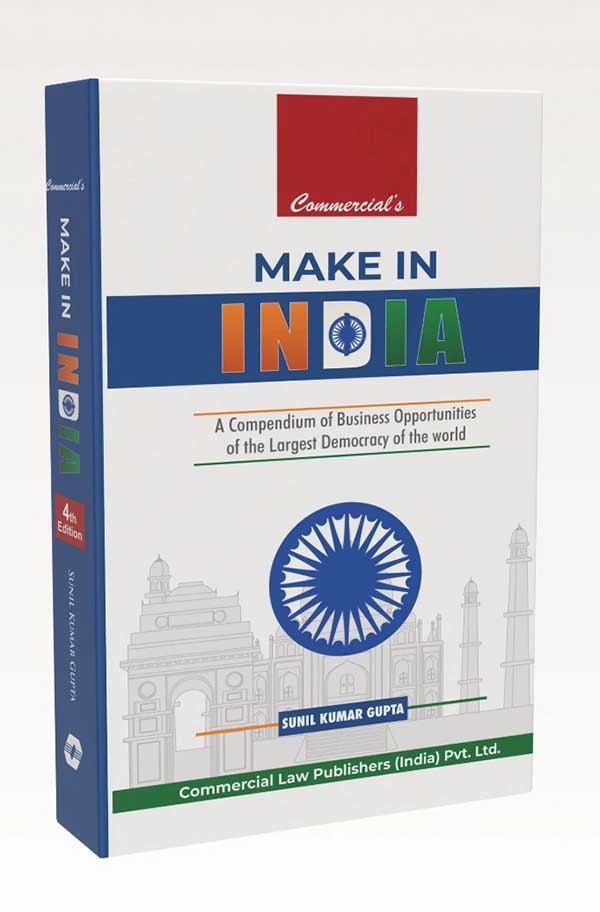

Make in India


Original price was: ₹1,295.00.₹971.00Current price is: ₹971.00.
(Flat 25% Discount for a limited period + Free Shipping)
| Book Name | Make in India |
|---|---|
| Author | Sunil Kumar Gupta |
| Publisher | Commercial Law Publishers |
| Edition | 4th edition, 2027 |
| ISBN | 9789378331657 |
| Pages | 488 |
Frequently bought together
- Description
- Additional information
- Reviews (0)
Description
Discover the wealth of opportunities awaiting in the largest democracy in the world with “Make in India,” authored by Sunil Kumar Gupta. This insightful compendium, now in its 4th edition (2027), provides a comprehensive guide to the business landscape of India. With a generous flat 25% discount for a limited period and free shipping, this book offers incredible value. Featuring 448 pages of valuable content, the ISBN 9789378331657, and published by Commercial Law Publishers, it delves into essential topics including inclusive economic growth, ease of doing business, foreign investment policies, and more. Whether you’re an entrepreneur, investor, or enthusiast, this book is your gateway to understanding the Indian business ecosystem and seizing opportunities.
Detailed Contents
| Chapter | Contents | Page |
|---|---|---|
| Foreword — Dr. Pramod Sawant | iii | |
| Foreword — Baroness Verma | iv | |
| Foreword — Kalraj Mishra | v | |
| Foreword — Anandiben Patel | vi | |
| Foreword — Vijay Goel | vii | |
| Messages | ix | |
| Acknowledgment | xi | |
| Preface | xiii | |
| Chapter 1 — ABOUT BHARAT | ||
| Chapter 1 | Constitution of India | 1 |
| Chapter 1 | Fundamental Rights | 2 |
| Chapter 1 | General Profile | 3 |
| Chapter 1 | Political Profile | 5 |
| Chapter 1 | Economic Profile | 6 |
| Chapter 1 | Socio-Economic Structure | 8 |
| Chapter 1 | India’s Ranking (2025-26) | 9 |
| Chapter 1 | Unraveling GDP Growth and Easing Business Dynamics in India and the Global Economy | 10 |
| Chapter 1 | Real GDP Growth Projections for 2026: The World’s 50 Largest Economies | 11 |
| Chapter 1 | Summary | 12 |
| Chapter 2 — WHY INDIA: ADVANTAGES AND INCENTIVES FOR BUSINESS | ||
| Chapter 2 | 1. India and Its Competitors at a Glance | 14 |
| Chapter 2 | 2. A Large and Fast-Growing Domestic Market | 16 |
| Chapter 2 | 3. People and Skills | 17 |
| Chapter 2 | A large workforce with room to grow | 17 |
| Chapter 2 | Training at scale: ITIs and apprenticeships | 17 |
| Chapter 2 | The Labour Codes: what changes for employers | 18 |
| Chapter 2 | 4. Operating Costs | 19 |
| Chapter 2 | Wages at Japanese manufacturers | 19 |
| Chapter 2 | Minimum wages | 20 |
| Chapter 2 | Industrial land | 21 |
| Chapter 2 | 5. Incentives for Manufacturers | 21 |
| Chapter 2 | Production Linked Incentive (PLI) schemes | 22 |
| Chapter 2 | Semiconductors: Semicon India and Semicon 2.0 | 23 |
| Chapter 2 | Mobile Phone Manufacturing Scheme | 23 |
| Chapter 2 | Electronics Components Manufacturing Scheme (ECMS) | 24 |
| Chapter 2 | SEZs, bonded manufacturing and duty deferral | 25 |
| Chapter 2 | Export support | 25 |
| Chapter 2 | Credit, risk capital and jobs | 25 |
| Chapter 2 | 6. Corporate Taxes and Incentives Compared | 26 |
| Chapter 2 | India’s tax system | 27 |
| Chapter 2 | Tax holidays and the global minimum tax | 28 |
| Chapter 2 | 7. Infrastructure, Logistics and Power | 29 |
| Chapter 2 | Public investment and planning | 29 |
| Chapter 2 | 8. Digital Public Infrastructure and Easier Compliance | 30 |
| Chapter 2 | Digital public infrastructure | 30 |
| Chapter 2 | Easier compliance | 30 |
| Chapter 2 | 9. Access to World Markets | 31 |
| Chapter 2 | What the new agreements offer | 32 |
| Chapter 2 | How the comparators’ access differs | 33 |
| Chapter 2 | 10. India in the Global Economy: Takeaways from the G20 | 34 |
| Chapter 2 | India’s proposals at Johannesburg | 34 |
| Chapter 2 | India’s positions on the wider agenda | 35 |
| Chapter 2 | What this means for businesses | 36 |
| Chapter 2 | 11. Macroeconomic Stability and Institutions | 36 |
| Chapter 2 | A stable macroeconomic base | 36 |
| Chapter 2 | Institutions for investors | 37 |
| Chapter 2 | 12. Investors Are Choosing India | 37 |
| Chapter 2 | FDI in FY 2025-26 | 37 |
| Chapter 2 | New export industries | 38 |
| Chapter 2 | What Japanese companies say | 39 |
| Chapter 2 | 13. India Compared, Country by Country | 39 |
| Chapter 2 | 14. Points for Investors to Plan For | 41 |
| Chapter 2 | Summary | 43 |
| Chapter 3 — BUSINESS OPPORTUNITIES IN INDIA | ||
| Chapter 3 | Detailed Overview of potential Sectors | 45 |
| Chapter 3 | Agriculture and Allied | 45 |
| Chapter 3 | Market Size of Agriculture Sector | 46 |
| Chapter 3 | Auto Components, Automobile Industry and the EV Sector | 50 |
| Chapter 3 | Market Size | 51 |
| Chapter 3 | Government Policy and Initiative for Auto Components & Automobile Industry | 52 |
| Chapter 3 | Aviation Industry | 54 |
| Chapter 3 | Market Size of Aviation Sector | 55 |
| Chapter 3 | Banking Sector of India | 57 |
| Chapter 3 | Market Size of Banking Sector | 58 |
| Chapter 3 | Government Policy and Initiatives for Banking Sector | 59 |
| Chapter 3 | Biotechnology Sector | 60 |
| Chapter 3 | Defence Manufacturing | 64 |
| Chapter 3 | Market Size | 64 |
| Chapter 3 | Government Policy and Initiatives | 65 |
| Chapter 3 | E-commerce Industry | 67 |
| Chapter 3 | Market Size of E-commerce Industry | 68 |
| Chapter 3 | Government Policy and Initiatives for E-commerce Industry | 68 |
| Chapter 3 | Electronic System Design and Manufacturing (ESDM) | 70 |
| Chapter 3 | Semiconductor Industry | 74 |
| Chapter 3 | Market Size of Semiconductor Sector | 75 |
| Chapter 3 | Government Policy and Initiatives for Semiconductor Sector | 76 |
| Chapter 3 | Data Centre/Data Warehouse Industry | 78 |
| Chapter 3 | Market Size of Data Centre/Data Warehouse Sector | 78 |
| Chapter 3 | Government Policy and Initiatives for Data Centre/Data Warehouse Industry | 79 |
| Chapter 3 | Engineering Sector | 80 |
| Chapter 3 | Market Size of Engineering Sector | 81 |
| Chapter 3 | Government Policy and Initiatives for Engineering Sector | 82 |
| Chapter 3 | FMCG Industry | 83 |
| Chapter 3 | Government Policy and Initiatives for FMCG Industry | 84 |
| Chapter 3 | Healthcare Industry | 86 |
| Chapter 3 | Market Size of the Healthcare Industry | 87 |
| Chapter 3 | Government Policies and Initiatives for Healthcare Industry | 88 |
| Chapter 3 | Infrastructure Sector | 89 |
| Chapter 3 | Market Size of Infrastructure Sector | 91 |
| Chapter 3 | Government Initiatives and Development in Infrastructure Sector | 94 |
| Chapter 3 | IT and BPM Industry | 96 |
| Chapter 3 | Market Size of IT and BPM Industry | 97 |
| Chapter 3 | Government Policy and Initiatives | 97 |
| Chapter 3 | Manufacturing Sector | 99 |
| Chapter 3 | Market Size in Manufacturing Sector | 100 |
| Chapter 3 | Some major achievements of manufacturing sector – (2026) | 101 |
| Chapter 3 | Medical Devices Industry | 106 |
| Chapter 3 | National Medical Devices Policy, 2023 | 107 |
| Chapter 3 | The National Medical Devices Policy, 2023 has several salient features | 108 |
| Chapter 3 | Strategies to Promote the Medical Device Sector | 108 |
| Chapter 3 | Market Size of Medical Device Industry | 109 |
| Chapter 3 | Government Policy and Initiatives | 110 |
| Chapter 3 | Metals and Mining Industry Sector | 112 |
| Chapter 3 | Government Policy and Initiatives in Metals and Mining Sector | 115 |
| Chapter 3 | Oil and Gas Industry | 117 |
| Chapter 3 | Market Size of Oil and Gas Industry | 117 |
| Chapter 3 | Pharmaceuticals Sector | 119 |
| Chapter 3 | Market Size of Pharmaceuticals Sector | 120 |
| Chapter 3 | Shipping Industry and Ports in India | 124 |
| Chapter 3 | Market Size of Shipping Industry and Ports | 125 |
| Chapter 3 | Government Policy and Initiatives | 126 |
| Chapter 3 | Railways Sector | 130 |
| Chapter 3 | Market Size of Railway Sector | 132 |
| Chapter 3 | Government Policy and Initiatives of Railway Sector | 133 |
| Chapter 3 | Renewable Energy Industry | 136 |
| Chapter 3 | Market Size for the Renewable Energy Sector | 136 |
| Chapter 3 | Government Policy and Initiatives for the Renewable Energy Sector | 137 |
| Chapter 3 | Science and Technology Industry | 139 |
| Chapter 3 | Market Size of the Science and Technology Industry | 139 |
| Chapter 3 | Telecommunications Industry | 143 |
| Chapter 3 | Market Size of the Telecommunications Industry | 144 |
| Chapter 3 | Tourism and Hospitality Industry | 146 |
| Chapter 3 | Market Size of the Tourism and Hospitality Industry | 147 |
| Chapter 3 | Government Policy and Initiative of the Tourism and Hospitality Industry | 147 |
| Chapter 3 | Summary | 149 |
| Chapter 4 — SETTING UP A BUSINESS OR FACTORY IN INDIA: STEP BY STEP | ||
| Chapter 4 | Before You Start: Choosing the Entry Route and the Business Vehicle | 159 |
| Chapter 4 | Step 1: Incorporating the Company | 161 |
| Chapter 4 | Step 2: Bringing In the Investment and Reporting It | 162 |
| Chapter 4 | Step 3: Tax and Trade Registrations | 163 |
| Chapter 4 | Step 4: Finding Land and a Site | 165 |
| Chapter 4 | Step 5: Approvals to Build and Run a Factory | 167 |
| Chapter 4 | Step 6: Hiring People and Labour Compliance | 169 |
| Chapter 4 | Step 7: Claiming Incentives | 172 |
| Chapter 4 | State Incentives: Examples from Leading States | 175 |
| Chapter 4 | Indicative Timeline | 177 |
| Chapter 4 | A Checklist for Investors | 179 |
| Chapter 4 | Summary | 180 |
| Chapter 5 — EASE OF DOING BUSINESS AND STARTUP ECOSYSTEM IN INDIA | ||
| Chapter 5 | What is Ease of Doing Business & How it is Measured? | 183 |
| Chapter 5 | Measures to Promote Ease of Doing Business (EoDB) | 184 |
| Chapter 5 | Starting a Business | 184 |
| Chapter 5 | Registering Property | 185 |
| Chapter 5 | Dealing in Construction Permits | 185 |
| Chapter 5 | Obtaining Electricity | 185 |
| Chapter 5 | Resolving Insolvency | 186 |
| Chapter 5 | Paying Taxes | 186 |
| Chapter 5 | Trading Across Borders | 187 |
| Chapter 5 | Protecting Minority Investors | 188 |
| Chapter 5 | Enforcing Contracts | 188 |
| Chapter 5 | Business Reforms Action Plan 2024 | 189 |
| Chapter 5 | Startup Ecosystem in India | 189 |
| Chapter 5 | Unicorns in India | 191 |
| Chapter 5 | Programs Implemented under Startup India initiative | 191 |
| Chapter 5 | Summary | 194 |
| Chapter 6 — FOREIGN INVESTMENT POLICIES | ||
| Chapter 6 | Foreign Direct Investment in India | 198 |
| Chapter 6 | Share of Top 10 Investing Countries in FDI Equity Inflows, FY 2024-25 and FY 2025-26 (Amt. in USD Million) | 200 |
| Chapter 6 | State-wise Inflow of FDI | 200 |
| Chapter 6 | Sector-wise Inflow of FDI in India | 200 |
| Chapter 6 | Foreign Investment Facilitation Portal (FIFP) | 201 |
| Chapter 6 | Competent Authorities for Approval/Rejection of Foreign Investment | 202 |
| Chapter 6 | Census on Foreign Liabilities and Assets of Indian Direct Investment Entities for 2024-25 | 205 |
| Chapter 6 | Procedure for Receiving Foreign Direct Investment | 206 |
| Chapter 6 | Sectors under which Prior Approval of Government is Required | 216 |
| Chapter 6 | Eligible investors for FDI investment in India as per the Consolidated FDI Policy (effective from October 15, 2020, as amended up to Press Note 3 (2026 Series)) | 217 |
| Chapter 6 | Entities Eligible for FDI Investment in India | 218 |
| Chapter 6 | Sectors Prohibited From FDI | 222 |
| Chapter 6 | Permitted Sectors to receive FDI in India | 222 |
| Chapter 6 | Reporting Process | 231 |
| Chapter 6 | OVERSEAS DIRECT INVESTMENT | 233 |
| Chapter 6 | 1. Overseas Investment by Resident Individuals | 233 |
| Chapter 6 | 2. Overseas Investment by a Person Resident in India, Other than an | 235 |
| Chapter 6 | 3. Overseas Investment in an IFSC in India By an Indian Resident | 236 |
| Chapter 6 | Overseas Direct Investment and Indian Economy | 238 |
| Chapter 6 | Summary | 239 |
| Chapter 7 — RELEVANT EXTRACTS FROM THE FOREIGN TRADE POLICY | ||
| Chapter 7 | Important Extracts of FTP 2023: Reproduced for Ready Reference | 245 |
| Chapter 7 | 1. Legal Framework and Trade Facilitation | 245 |
| Chapter 7 | 2. General Provisions Regarding Imports and Exports | 252 |
| Chapter 7 | 3. Developing Districts as Export Hubs | 266 |
| Chapter 7 | 4. Duty Exemption/Remission Schemes | 268 |
| Chapter 7 | 9. Promoting Cross Border Trade in Digital Economy | 283 |
| Chapter 7 | Summary | 286 |
| Chapter 8 — MICRO, SMALL AND MEDIUM ENTERPRISES (MSME) | ||
| Chapter 8 | MSME New Registration Process is as follows | 288 |
| Chapter 8 | MSME Sector – Classification | 290 |
| Chapter 8 | Union Budget and Related Measures to Promote MSME Sector | 293 |
| Chapter 8 | Credit Guarantee to MSMEs | 293 |
| Chapter 8 | MSMEs and Professionals | 294 |
| Chapter 8 | Start-up | 294 |
| Chapter 8 | Entity DigiLocker | 294 |
| Chapter 8 | Major Government Initiatives and Schemes to Promote MSME Sector | 294 |
| Chapter 8 | 1. Micro, Small and Medium Enterprises Development (MSMED) Act, 2006 | 294 |
| Chapter 8 | 2. Schemes of the Ministry of MSME | 295 |
| Chapter 8 | How has Make in India proven to be a Game Changer for MSME Sector in India? | 307 |
| Chapter 8 | Fundamental Announcements & Achievements | 308 |
| Chapter 8 | Key MSME Initiatives and Developments | 310 |
| Chapter 8 | 1. Udyami Bharat | 310 |
| Chapter 8 | 2. Public Procurement Policy for Micro and Small Enterprises | 311 |
| Chapter 8 | 3. Procurement and Marketing Support (PMS) Scheme | 311 |
| Chapter 8 | 4. International Cooperation Scheme | 311 |
| Chapter 8 | 5. Technology Centres | 312 |
| Chapter 8 | 6. Skilling | 312 |
| Chapter 8 | 7. Promotion of MSMEs among SC/STs & in NER | 312 |
| Chapter 8 | 8. MSME SAMADHAAN: To Address Delayed Payment to MSEs | 314 |
| Chapter 8 | 9. MSME Sampark | 314 |
| Chapter 8 | 10. Digital Payments | 314 |
| Chapter 8 | 11. Special Measures under Aatmanirbhar Bharat Abhiyaan | 315 |
| Chapter 8 | 12. ` 50,000 crores Equity Infusion for MSMEs through Self Reliant India Fund (Fund of Funds) | 315 |
| Chapter 8 | 13. MSME Sambandh Portal | 315 |
| Chapter 8 | 14. PM Vishwakarma Scheme | 316 |
| Chapter 8 | Activities Conducted For North-Eastern Region, Women, Person with Disability, and International Cooperation | 317 |
| Chapter 8 | A. Promotion of MSMEs in North Eastern Region and Sikkim – Central Government Scheme | 317 |
| Chapter 8 | B. Development of New and Existing Industrial Estates | 318 |
| Chapter 8 | C. Activities for Women-led MSMEs | 318 |
| Chapter 8 | D. Activities for Persons with Disabilities (PwD) | 318 |
| Chapter 8 | International Cooperation | 319 |
| Chapter 8 | GeM (Government e-Marketplace) Portal | 319 |
| Chapter 8 | Summary | 321 |
| Chapter 9 — ENTRY OPTIONS IN INDIA | ||
| Chapter 9 | Types of Business Entities in India | 329 |
| Chapter 9 | Sole Proprietorship | 329 |
| Chapter 9 | One Person Company (OPC) | 331 |
| Chapter 9 | Partnership | 333 |
| Chapter 9 | Limited Liability Partnership (LLP) | 335 |
| Chapter 9 | Company | 337 |
| Chapter 9 | Joint Venture (JV) | 340 |
| Chapter 9 | Wholly Owned Subsidiary (WOS) | 341 |
| Chapter 9 | Branch or Liaison or Project Offices | 343 |
| Chapter 9 | Establishment of Branch Office (BO)/Liaison Office (LO)/Project Office (PO) or any other place of business in India by foreign entities | 344 |
| Chapter 9 | Summary | 354 |
| Chapter 10 — FUNDING OPTIONS IN INDIA | ||
| Chapter 10 | Ways Through which Capital Instruments are Permitted in India | 359 |
| Chapter 10 | 1. Equity Shares | 359 |
| Chapter 10 | 2. Preference Shares | 359 |
| Chapter 10 | 3. Debentures | 361 |
| Chapter 10 | 4. External Commercial Borrowings (ECBs) | 365 |
| Chapter 10 | 5. Foreign Currency Convertible Bonds (FCCBs) | 370 |
| Chapter 10 | Cost of acquisition on conversion of FCCBs | 372 |
| Chapter 10 | Taxation on Foreign Currency Convertible Bonds | 373 |
| Chapter 10 | 6. Foreign Currency Exchangeable Bonds (FCEB) | 373 |
| Chapter 10 | Benefits of Foreign Currency Exchangeable Bonds (FCEBs) | 373 |
| Chapter 10 | Issue of Foreign Currency Exchangeable Bonds Scheme, 2008 | 374 |
| Chapter 10 | Pricing and Maturity | 375 |
| Chapter 10 | Foreign Funding Sources in India | 377 |
| Chapter 10 | Foreign Portfolio Investors (formerly Foreign Institutional Investors) | 377 |
| Chapter 10 | Foreign Portfolio Investment (FPI) | 377 |
| Chapter 10 | Foreign Venture Capital Investor (FVCI) | 378 |
| Chapter 10 | Traditional Funding Sources in India | 378 |
| Chapter 10 | 1. Bank Loans | 378 |
| Chapter 10 | 2. Government Grants | 380 |
| Chapter 10 | 3. Loans from Financial Institutions | 381 |
| Chapter 10 | Summary | 382 |
| Chapter 11 — BUSINESS LAWS AND REGULATORS | ||
| Chapter 11 | Major Business Regulators in India | 388 |
| Chapter 11 | Reserve Bank of India (RBI) | 388 |
| Chapter 11 | The Securities and Exchange Board of India (SEBI) | 389 |
| Chapter 11 | Powers and Functions of the Board | 389 |
| Chapter 11 | Ministry of Corporate Affairs (MCA) | 391 |
| Chapter 11 | Ministry of Finance | 391 |
| Chapter 11 | Ministry of Electronics and Information Technology (MeitY) | 392 |
| Chapter 11 | Food Safety and Standards Authority of India (FSSAI) | 393 |
| Chapter 11 | Insurance Regulatory and Development Authority of India (IRDAI) | 394 |
| Chapter 11 | Telecom Regulatory Authority of India (TRAI) | 395 |
| Chapter 11 | Central Electricity Regulatory Commission (CERC) | 396 |
| Chapter 11 | Petroleum and Natural Gas Regulatory Board (PNGRB) | 396 |
| Chapter 11 | National Highways Authority of India (NHAI) | 397 |
| Chapter 11 | Khadi and Village Industries Commission (KVIC) | 397 |
| Chapter 11 | Directorate General of Civil Aviation (DGCA) | 398 |
| Chapter 11 | Directorate General of Foreign Trade (DGFT) | 398 |
| Chapter 11 | Directorate General of Hydrocarbons (DGH) | 399 |
| Chapter 11 | Competition Commission of India (CCI) | 399 |
| Chapter 11 | Central Drugs Standard Control Organization (CDSCO) | 400 |
| Chapter 11 | National Bank for Agriculture and Rural Development | 400 |
| Chapter 11 | Bureau of Indian Standards (BIS) | 400 |
| Chapter 11 | National Green Tribunal | 401 |
| Chapter 11 | Small Industries Development Bank of India (SIDBI) | 401 |
| Chapter 11 | Overview of the Corporate Law Regime in India and Proposed Legal Changes | 401 |
| Chapter 11 | Law and Adaptation to Changing Circumstances | 402 |
| Chapter 11 | Growth of the Corporate Regulatory Framework | 403 |
| Chapter 11 | Corporate Laws | 403 |
| Chapter 11 | The Companies Act, 2013 | 403 |
| Chapter 11 | The Companies (Amendment) Act, 2020 (extract: sections 1 to 51) | 404 |
| Chapter 11 | CSR Implementation | 404 |
| Chapter 11 | The Indian Partnership Act, 1932 | 419 |
| Chapter 11 | The Limited Liability Partnership Act, 2008 | 420 |
| Chapter 11 | New Labour Codes (in force from 21st November, 2025) | 431 |
| Chapter 11 | The Prevention of Money-laundering Act, 2002 | 435 |
| Chapter 11 | Special Economic Zones Act, 2005 | 437 |
| Chapter 11 | The Competition Act and The Competition (Amendment) Act, 2023 | 440 |
| Chapter 11 | The Insolvency and Bankruptcy Code | 440 |
| Chapter 11 | Securities and Exchange Board of India (Listing Obligations and Disclosure Requirements) Regulations, 2015 | 441 |
| Chapter 11 | Cyber Laws in India | 441 |
| Chapter 11 | Intellectual Property Laws | 443 |
| Chapter 11 | The Patents Act, 1970 | 444 |
| Chapter 11 | The Patents (Amendment) Rules, 2021 | 444 |
| Chapter 11 | The Designs Act, 2000 and The Designs (Amendment) Rules, 2021 | 444 |
| Chapter 11 | The Trade Marks Act, 1999 | 445 |
| Chapter 11 | The Copyright Act, 1957 | 446 |
| Chapter 11 | The Geographical Indications of Goods (Registration and Protection) Act, 1999 | 447 |
| Chapter 11 | Other Important Acts | 448 |
| Chapter 11 | Taxation in India | 449 |
| Chapter 11 | GST: Major Tax Reform in India | 450 |
| Chapter 11 | Income Tax in India | 451 |
| Chapter 11 | Income Tax Exemption for Startups | 451 |
| Chapter 11 | Summary | 452 |
| Chapter 11 | Other Important Acts | 455 |
Additional information
| Publisher | Commercial |
|---|






Reviews
There are no reviews yet.